
After the Gate Opens
What the Herd Knows About How Systems Move

Leadership with horses begins when we stop trying to make them move and start making sense.
I used to think this only applied in the pasture.
I’ve learned, slowly, that it works the same way with people.
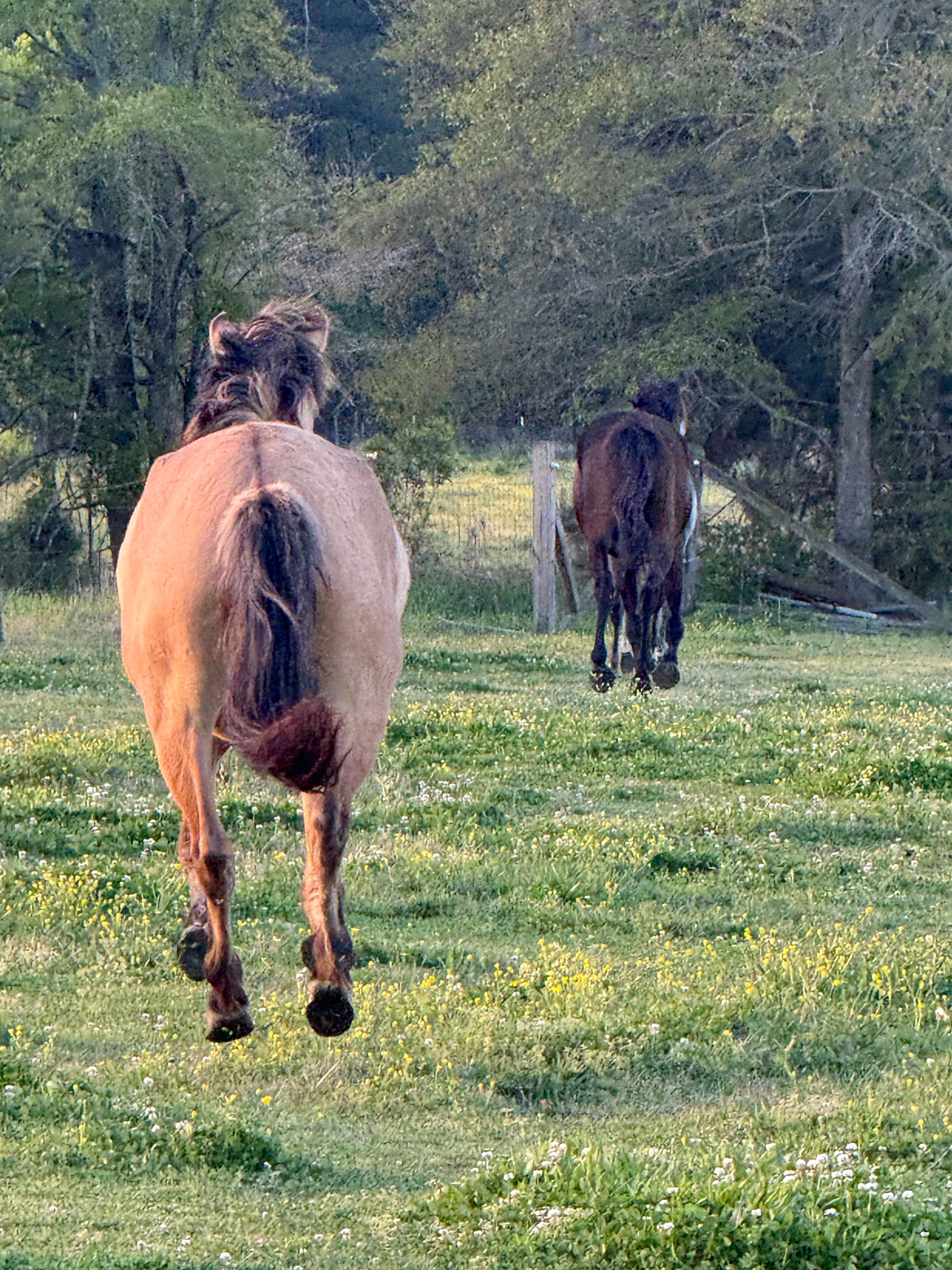
Each morning, after feeding the herd at Double C Stables and releasing them from their stalls, I watch the same pattern assemble itself.
No matter who exits the barn first, or how much energy the younger horses release into the field, the herd does not enter the back pasture, the safest, richest space, until Reese or Arty enters. The fastest horses are rarely the first to arrive. The ones with the most authority never hurry.
I wrote about this recently, staying with what I could see rather than what it might mean. Sitting with it longer, I’m beginning to recognize something familiar, not just in the pasture, but in human systems as well.
How Systems Actually Move
Brené Brown’s research on trust and psychological safety points to something similar: that groups don’t move because someone demands alignment, but because enough safety exists for people to risk participation.
We often describe movement in organizations as requiring pressure: deadlines, urgency, incentives, and the force of personality. We reward decisiveness that looks like speed and visibility. We celebrate leaders who “drive” change.
But in practice, especially in moments of uncertainty, systems rarely move because someone pushes harder.
They move when anxiety drops enough for people to orient.
In the herd, movement toward the back pasture isn’t chaotic, even when the field is full of exuberance. The younger horses burn energy, circle, and test the air. But they do not cross the threshold until the emotional field settles. That threshold belongs to Reese and Arty. They don’t chase that settlement; they embody it. Reese is the lead mare, and Arty is the lead gelding.
Watching closely, it becomes clear that the herd isn’t following authority as much as it is following regulation.
Thresholds Tell the Truth
In organizational research, we often talk about how anxiety spreads faster than clarity. What I see in the pasture each morning mirrors that insight: movement doesn’t follow the loudest signal; it follows the one that settles the field enough for choice to return.
Every system has thresholds. In organizations, these thresholds show up as:
Strategic decisions that stall
Meetings that circle but never commit
Change initiatives that generate motion without direction
Teams that move fast but feel strangely brittle
What I’m noticing, both in the pasture and in human spaces, is that thresholds aren’t crossed by the most kinetic energy. They’re crossed when enough stability is present to make movement feel safe.
In the herd, crossing first by Reese or Arty doesn’t signal dominance. It signals availability. It tells the others: this path has been assessed; you don’t have to hold the risk alone.
In human systems, the leaders people trust most in uncertainty often do something similar. They don’t rush the group across the threshold. They don’t demand alignment before it exists. They stand in the tension just long enough for orientation to return.
Influence Without Expenditure
Another pattern keeps revealing itself the longer I watch.
Reese and Arty use remarkably little energy to maintain their influence. They don’t repeat themselves. They don’t escalate unless necessary. Most of the time, their presence alone shapes the group's motion.
In contrast, predatory systems, whether equine or human, consume enormous energy just to maintain order. They rely on fear, pressure, and constant correction. Movement happens, but it is costly. Exhaustion accumulates. Trust erodes.
I recognize this difference immediately in organizations I’ve worked in. Some environments require constant vigilance, reading the mood, anticipating reactions, and managing impressions. Others allow people to settle into themselves and do their work.
The difference often isn’t policy or structure. It’s whether someone in the system is consistently reducing anxiety rather than amplifying it.
Leadership as a Field, Not a Position
One of the most surprising things about watching my herd is how seldom leadership announces itself.
Sometimes Reese leads the way into the pasture. Sometimes Arty lingers at the back, making sure no one is left behind. Their roles shift without explanation or threat. Authority flows where it’s needed.
Human systems tend to struggle with this fluidity. We expect leadership to be static, visible, and continuously assertive. But living systems don’t operate that way for long.
What I’m beginning to trust, slowly, is that leadership functions less like a trait and more like a field. It’s something generated between bodies, shaped by timing, context, and care. It can’t be forced into existence without consequences.
Why Horses Keep Me Honest
I return to the pasture every morning not because horses offer neat metaphors, but because they won’t let me lie to myself.
They respond to what is actually present, not to intention, or title, or aspiration. If something feels unsafe, incongruent, or rushed, they immediately reorganize around it.
That makes the pasture holy ground for me, not because it is sacred in concept, but because it demands integrity in practice.
Watching Reese and Arty steady the herd day after day, I’m learning to ask different questions about leadership in my own life and work.
Not “How do I move things forward?” but “What am I stabilizing simply by how I show up?” Not “How do I claim authority?” but “What kind of presence helps others cross thresholds without fear?”
I don’t have tidy answers yet. For now, I’m learning to stand still a little longer. To let movement come to me. And to trust that ethical influence, like good ground, takes time to reveal itself.