
You Are Enough
What a mirror, a mare, and a young rider reminded me about women, leadership, and belonging

What horses know, and what leadership so often forgets, is that presence cannot be performed.
— Horses and Holy Ground
I saw a photograph today that I have not been able to leave alone.
It was one image among many from an obstacle course this weekend, but this one stopped me.
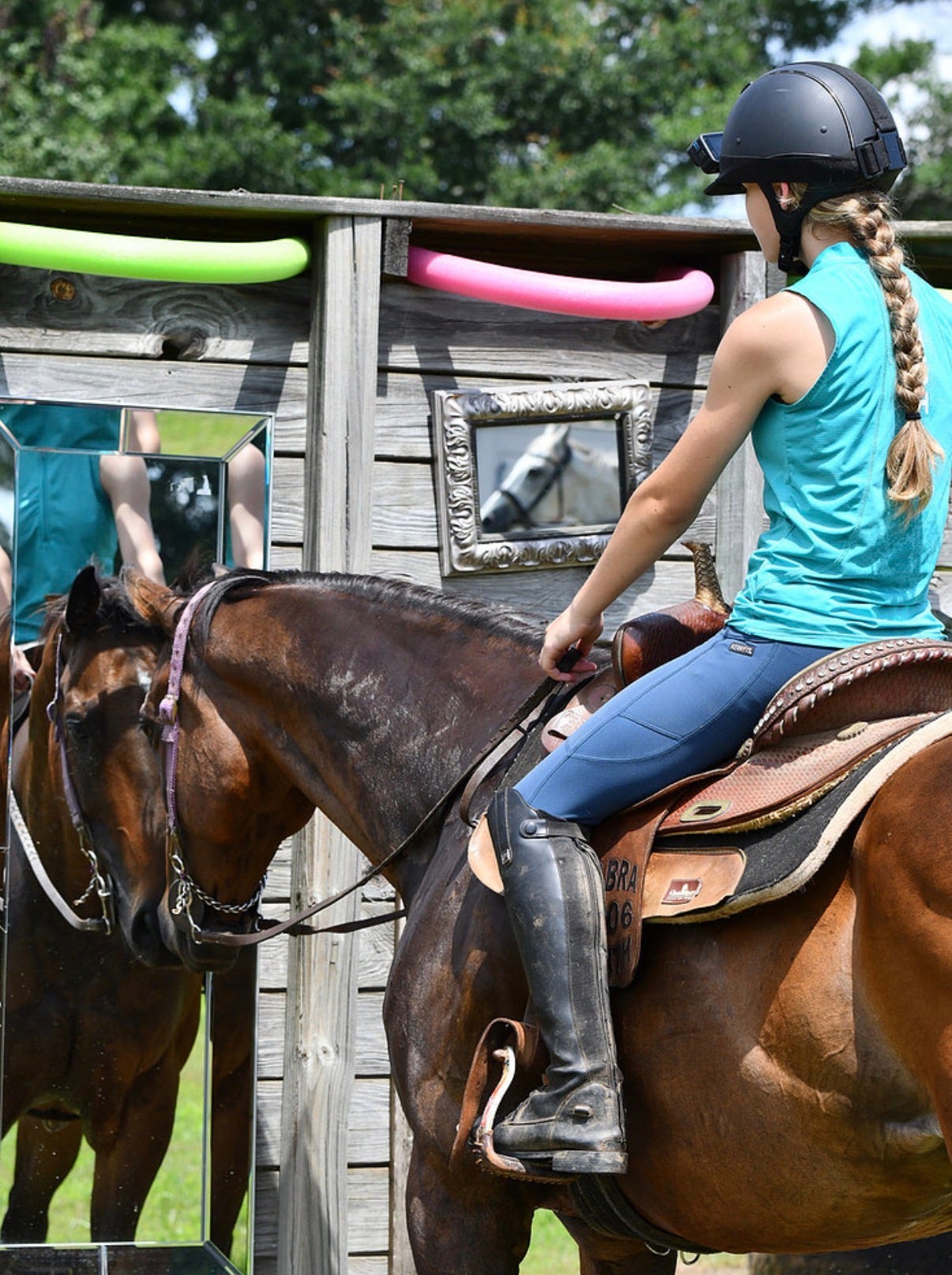
Li’l Miss Camille, our retired racehorse with a history written in her body, stood before a mirror with her young rider in the saddle, a girl still close enough to the beginning to believe in big things.
Camille was looking at herself.
Not performing. Not bracing. Not asking whether she belonged in the frame.
Just meeting her own reflection, honestly and without apology.
I do not know exactly what the young girl saw from the saddle in that moment. I do not know what passed between a young rider and a mare who has already lived more than one life. But I know what I saw when the picture landed in front of me: possibility.
Not polished, curated possibility. Not the kind that asks to be measured or approved. The holy kind. The kind that appears when a girl, a horse, and a mirror all tell the truth at once.
That image stayed with me because it showed the opposite of something I had learned too well: how quickly a room can ask you to edit yourself before you have even opened your mouth.
The invitation itself was an achievement of a particular kind, the kind you do not fully celebrate because you are busy making sure you deserve it. A university president, board members, executive leadership, and a few politicians all gathered after a compliance meeting at a table with its own architecture of belonging, its own invisible grammar for who spoke, how they spoke, and what counted as acceptable language.
I arrived with the appropriate attire, the right degree, the correct title. I held my posture in place all evening. I paid close attention to my words, to my dialect, because I am Southern and a horse girl and that table was neither of those things. I had learned long before that dinner which parts of myself were legible in certain rooms and which parts were often asked to wait.
At some point the conversation turned to teamwork and leadership, and I felt it rise in me, the most vivid and true example I had ever encountered, drawn from years in the horse barn, from watching herd dynamics teach me everything the organizational development textbooks were still trying to explain. I knew exactly what I wanted to say. I knew it was right.
And I left it in my pocket.
Not because I lacked confidence. Not because the example was not good enough. But because I had learned, the way we do, quietly and over time and often without anyone saying it directly, that the horse barn was not expected at that table.
My fluency in one world was not yet treated as currency in another. The polished version of me had been invited. The whole of me would have to wait for a wider room.
I have thought about that moment more times than I can count. Not with bitterness, because that is not where this story lives, but with a clearer understanding now: I was not the one who needed to become smaller. The room needed to become larger.
The equestrian world has its own version of that table.
Anyone who has spent real time in it knows what I mean. There is a hierarchy that announces itself in ways both spoken and unspoken, in bloodlines and barn affiliations, in disciplines and budgets and the particular cut of your breeches, in which trainer you ride with and which shows you attend and whether your horse is the kind of horse that makes people look twice when you enter the ring.
It is a world I love with my whole heart and have loved for most of my life, and it is also a world that can make you feel, on certain days, in certain company, like you are still auditioning for a part you thought you’d already been given, even as a grown woman.
When I transitioned disciplines and began attending larger shows, I felt it again. The same recalibration happening somewhere below conscious thought, the same quiet audit of whether I was enough for this particular room.
We have a name for that now, imposter syndrome, though the name has always felt too small for what it is. It is not only self-doubt. Sometimes it is the body remembering every room where only part of you was welcome.
I have felt it at university dinners and horse shows and networking events and strategic planning meetings, and what I know now is that it is not always a personal failing. Sometimes the problem is not that we do not belong in the room. Sometimes the room needs to be remade with enough space for the whole truth to walk in.
As a grown woman, I can name that now. I have years behind me, language for what I once only felt, and enough hard-won certainty to know when a room needs changing.
But the girls are still at the beginning, before language, before armor, before the hard-won certainty that takes years to grow.
This is why it matters so much that young girls learn, early and often, that they do not have to become smaller to be taken seriously, and why it matters just as much that grown women in leadership remember the same thing.
A fourteen year old girl standing at the edge of a dream is still deciding what parts of herself are welcome.
A woman at the conference table may have spent decades learning which parts to edit before she speaks.
Both deserve another way. Both deserve to know they can bring the whole of themselves with them: softness and strength, questions and conviction, barn dirt and big ideas, courage before it knows how to explain itself, and wisdom that no longer feels the need to.
The dreams that go quiet before anyone else ever hears them are the ones we have a responsibility to protect.
There came a day when I stopped leaving myself at the door.
I had transitioned to another university, and the leadership just above me had moved on, and I found myself responsible for helping my team determine how we would work together, how we would function, how we would hold one another up in service of something larger than any one of us.
And I brought the barn into the room. I used the language of the herd, the vocabulary of horses, the framework that had always made the most sense to me for understanding how human beings move together toward a common purpose.
The executive leadership did not quite know what to do with it. My team, who knew me, and who had seen the whole of me over time, received it. And I did not take it back.
That was courage. Not the kind that announces itself with trumpets, but the quiet, deliberate kind, the kind that says: this is the truest thing I know how to offer, and I am going to offer it and let it land where it lands.
I had spent years learning to offer the polished version of myself in rooms that required it, and there is wisdom in that, there is a time for every kind of knowing. But the whole of me, the woman who sees the herd in every team and the round pen in every difficult conversation, had been waiting a long time for her turn to speak.
She has not stopped speaking since.
Which brings me back to Li’l Miss Camille and her young rider, who did not choose an easy horse.
She could have. There are easier horses, horses with quieter histories and simpler needs, horses that do not carry the memory of starting gates and racing silks and a first life lived entirely in service of speed. She chose Camille. A retired racehorse finding her second life, learning that her worth was never only in her velocity, that there was something on the other side of the gate worth discovering. Two beings, practicing courage together.
What Camille is teaching her, without a word, without a lesson plan, simply by being exactly and unashamedly what she is, is something I wish someone had said to me at that university dinner and something I still believe leadership needs to hear.
I want the equestrian world to say it louder to its youngest members.
I want professional rooms to make space for it, too.
You do not have to shrink yourself to fit a room that was never built with enough space. Sometimes your presence is part of how the room learns to grow.
You are enough. I see you, and you are enough.
Camille walked up to that mirror and looked at her own reflection with the full weight of her history and the full presence of who she has become, and she did not flinch. She was not measuring herself against the horse in the next stall. She was not adjusting her presentation for the audience. She was simply meeting herself, honestly and without apology, in the frame of the mirror.
In the saddle, her steady companion watched her do it.
And I believe, with everything in me, that something passed between them in that moment that no trainer could have planned and no curriculum could have taught.
A wordless teaching from one living creature to another that said: this is what it looks like to belong to yourself completely. This is what courage looks like when it has nothing to prove.
Horses have always been able to read what I could not yet name in myself.
Before I had language for the tense shoulders and the shortened breath, before I understood that the quiet tug I kept ignoring was my own inner life trying to get my attention, the horses knew.
They felt the truth in my body before I could feel it myself. They waited, with the infinite patience of creatures who understand that presence cannot be rushed, for me to return to myself before they took a single step forward.
That is part of what horses teach us: how to notice when we have left ourselves behind, and how to come back before we ask anyone else to follow.
I am writing a book about what happens in the barn when we stop performing and start listening. About presence, authenticity, reverence, integrity, and stewardship, not as ideas to admire from a distance, but as ways of returning to ourselves and leading from that place. Lived fully, those principles change not just how we ride, but how we lead teams, make decisions, enter rooms, tell the truth, and stand before the mirror without flinching.
I am writing it for the woman who left her truest example in her pocket, and for the woman who is ready to bring it into the room.
For every woman who has ever recalibrated herself for a room that had not yet learned how to receive the whole of her, and for every leader who suspects the work now is not to perform belonging, but to make belonging possible for others.
And for Camille’s young partner. For the girls just arriving at the edge of their own big dreams, watching the women ahead of them to see whether the dream is too large, whether they are too small, whether anyone in the room knows how to make space.
A retired racehorse, finding her second life.
A girl, learning that big dreams do not require her to become small.
A mirror, telling the truth to anyone brave enough to look.
If you want to follow the book, the barn stories, and the slow practice of leading with the whole self, I would love to have you along.
katrina-mintz.com